
Information is Real
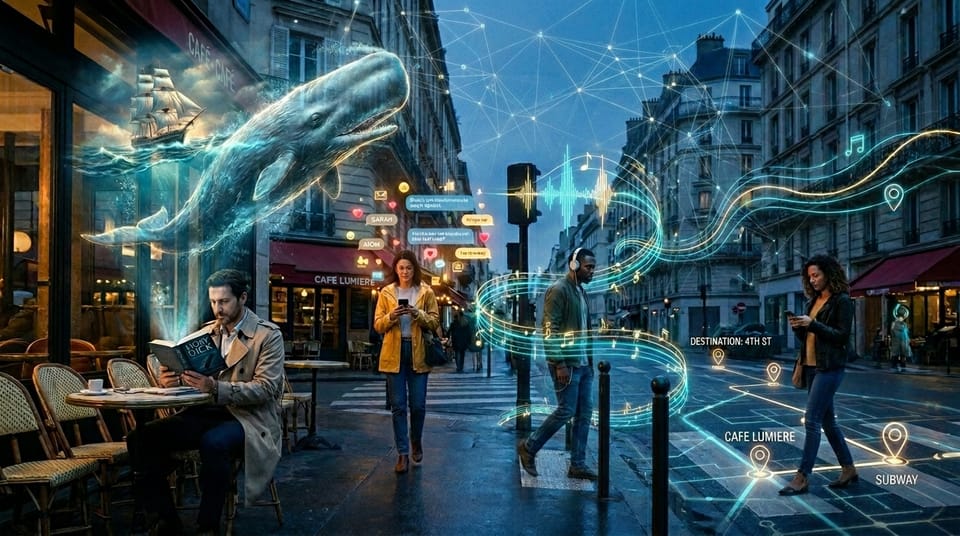
A book rests in your hands.
You have held thousands of them. The physical fact of a book is so familiar that it almost disappears from notice: paper bound between covers, ink arranged on pages, a weight in the hand, maybe a comforting musty odor. A simple object, nothing apparently remarkable.
Looking closer, a book is a volume of symbols, marks on pages, a compilation of technologies. The ink shape on this page and the ink shape on that page are different physical objects. Different ink, different fibers, yet instances of the same letter. The mark is particular, the letter is not.
The mark exists in the ink. The letter is hosted by the ink, but it is not identical to it. It belongs to a conceptual system: an alphabet, an abstract pattern that survives across every instance of the letter ever printed, written, displayed, or carved.
The symbols are arranged into words and sentences, expressing a language. English, in this case. But English is not the ink on the page, nor is it the alphabet which carries it. English is yet another abstraction, a system with its own grammar, its own logic, its own rules of combination. It can be encoded in Latin letters, in braille, in Morse, in audio waveforms. The language survives the substitution.
And the English is expressing the novel. Say, Moby-Dick. But Moby-Dick exists in French, in Japanese, in Russian. Different languages, different symbol systems, different physical objects on different shelves in different countries. We still call it the same novel. Something has crossed the boundary between physical representations and survived translation, reproduction, adaptation, and memory. The novel is carried by language, but it is not reducible to any one language.
And the novel carries the narrative: Ahab's obsession, the whiteness of the whale, the indifferent enormity of the sea. The narrative is a compelling account of what happened, and it is also a vehicle. It encodes something within it. A pattern, a perspective, a philosophy, whatever it is that makes a reader close the book and stare in contemplation at the wall for a minute. A different story entirely could deliver something recognizably adjacent. The narrative is what the happening reveals to the reader. The static component of a dynamic system that is only really complete at and after read-time.
At each level, one layer of abstraction gives way to the next. Ink carries symbols, symbols carry language, language carries the novel, the novel carries narrative, narrative carries meaning. Each layer is associated with the others, dependent on the others, but not identical to them.
It is not really a clean stack, more like a lattice. A dense arrangement of carriers, systems, conventions, and acts of recognition. But the basic notion is clear enough: the visible object is not the whole object. The thing in your hand is only the outermost layer of what is actually there. The book has physical weight, the meaning does not.
You can point to the paper, the ink, the page, the paragraph, the chapter. But the thing the book is for is not sitting at any single coordinate inside it. It has no weight of its own. One does not simply cut the book open to find the novel inside. You read it, reassemble the meaning of the symbols within the dynamic processes of a living human mind. The entire object is organized around this. The physical book, with all its heft and presence, is infrastructure.
A photograph is a physical print, or a pattern of pixels, or a file encoded on a drive. It is also an image, a rendering of something that was before a lens at a particular moment. Further still, it is a record and testament: this happened, perhaps this mattered, this person was here, this face looked this way, this moment captured. The print can fade and the file can be copied; the image can be displayed on a phone, projected on a wall, described to someone who never saw it. The photograph moves through carriers, what it carries is not exhausted by any of them.
A text message is a device, an app, a protocol, a character encoding, a string of words. It is also a communication between two people: a question, a promise, a wound, a joke, presence maintained across distance. All the technical layers serve this. The thing they serve has no physical weight, and still matters more than the screen.
A song is notation, acoustic vibration, magnetic pattern. It is also a structure of rhythm, melody, harmony, phrase. The song carries something further still: feeling and revelation that survives transposition, cover versions, bad humming in the shower, the ruined little version of it stuck in your head at midnight. Every instance is a medium, the song itself is a medium. What the song does to the listener and player is what all of it is for.
Same structure as the book. Layer upon layer of carrier and carried thing. Matter arranged around something that is not matter as static object, but still changes what matter becomes.
Now look at the Internet; the physical infrastructure is enormous. Cables lie across the ocean floor, connecting continents. Data centers consuming increasingly meaningful fractions of the world’s electricity. Satellites orbiting overhead. Cell towers, routers, fiber lines, server racks. Electromagnetic spectrum allocations. The largest communication apparatus the species has ever built.
On top of that sits another layer: programming languages, data transfer protocols, operating systems, browsers, databases, search engines, compression and encryption schemes, cloud platforms. Higher still, recommendation systems, payment rails, identity systems.
And on top of those: YouTube, Wikipedia, Gmail, TikTok, Discord, Instagram, Reddit, GitHub, Google Docs. Each layer a medium running on a medium underneath it. But YouTube is not the videos, Gmail is not the emails, Wikipedia is not the knowledge. The browser is not the internet. These are systems built to carry other things. Those other things — the videos, messages, articles, records, maps — are themselves carrying the same kind of thing the book has been carrying for hundreds of years.
Communication, meaning between minds, is the essence every layer of these systems is oriented around. Information. The book on the shelf and the planetary network are essentially the same thing, merely different in scale. One is paper, ink, binding, alphabet, language, story. The other is glass fiber, electricity, silicon, protocol, interface, platform, message. Both are physical systems built around something essential that still cannot be weighed.
We've been doing this the whole time; clay tablets, scrolls, codices, printing presses. Telegraph lines, telephone networks, radio towers, film reels. Magnetic tape, broadcast television, fiber optic cables. Satellites and data centers. Smartphones in every pocket.
Constantly, we build increasingly elaborate physical technology systems to preserve, transmit, transform, and act upon something that is not itself a physical object. The marks and signals are physical. The storage media are physical. But meaning is not simply sitting inside them. It becomes physically real, if anywhere, as distributed and non-identical patterns of activity in living brains.
The arrangement is not incidental, it is civilizational. We organize matter into these forms because of what they carry. We don't build libraries because paper is sacred. We don't build networks because cables are meaningful. The carrier has mass, it's what is carried that has consequence.
That distinction between the two is easy to miss because the carrier is what we can touch. We can hold the book in our hands, not the novel. We can see the screen, but experience the conversation. Inspect the print, but recall the memories. Hear the soundwave, but feel the song. The visible layer is rarely the deepest layer. Often it is only the surface through which the deeper, more meaningful, thing becomes available.
Information is real.
It must be carried, stored, expressed, encoded, remembered, and reconstructed. But it is not identical to any one of its media. It can move between them and survive their substitution. It can organize its carriers from within: through us, matter is rearranged around it.
Energy is spent on it. Institutions are built to preserve it. Lives are changed by receiving it, losing it, hiding it, discovering it, and misunderstanding it. Information affects and interacts deeply with the physical domain, which is too often mistaken for reality itself.